Emma

Midsummer in Stockholm

So Midsummer is a big deal in Sweden. As the longest day of the year draws closer, the shops start putting up big displays of sill and potatoes, adverts on TV start featuring the famous Midsummer pole and the queues in Systembolaget, the state-run alcohol shops, steadily grow longer. Not to mention, Midsummer is declared a public holiday. And as Sweden is a country whose northern regions see 24 hours of darkness in winter and whose southern regions are even covered with snow for several months of the year, the fuss around this annual celebration is pretty understandable.

midsummer pole

However, my first Midsummer in Stockholm was very anticlimactic. I waited patiently for the street parties and open air concerts that I was sure would be held in the capital, but nothing happened. When I wandered around outside, hoping to find some sort of entertainment, most shops were shut and most people had left the city altogether. I later found out that Midsummer is a time when Swedes often retreat to the countryside for a traditional Midsummer party. So this year I was prepared: I found a friend with a country house, I bought a selection of snaps and sill and even did a quick bit of Swedish language revision in preparation for the infamous Swedish drinking songs.

sill

The friend in question has a country house in the Stockholm archipelago—a collection of 30,000 islands about one hour’s drive from the centre of Stockholm—with quite gorgeous views over the Baltic Sea. A group of us took a boat out there and then spent Midsummer day sunbathing in the warm weather and weaving our best attempt at the traditional Midsummer wreaths made from laurel leaves and flowers.

stockholm archipelago

In the early evening we had our Midsummer meal. There were a few different types of sill, (which is essentially pickled herring), knäckerbröd (a light, crispy type of bread), boiled potatoes with dill, quiche, grädfill (sour cream) and then a selection of different flavours of snaps to accompany some rather dubiously-sung Swedish drinking songs. We even managed to pick and eat some wild chives that were growing by the house.

wild chives

It seems like this is a fairly typical Midsummer if you live in Stockholm: spending time with friends or family in the countryside, with the sharp taste of sill and snaps mixing on your tongue and singing songs long into the shortest night of the year. And it was well worth waiting two years for!

Secret Spaces of Stockholm

One of the first things you notice when you get to Stockholm it that the city is spread over several islands. One of these is a pretty little island called Skeppsholmen that is right in the centre of the city. It has a small park and a few cool museums on it, but its biggest attraction for me has always been what is hidden beneath the ground. Built deep into the rock, there is a series of secret tunnels that were used as the Swedish military command centre during World War II and the Cold War.

In Swedish they are called “Bergrummet” which literally translates to “the mountain room”, but more accurately means any space carved out of the ground. Usually, the tunnels are closed and inaccessible, but on one day every 4 years—the so-called “Secret Spaces” day organised by the Swedish National Property Board—members of the public are allowed to walk through them. So, a few days ago when they were opened, I grabbed the opportunity to explore this secret part of the city!

Bergrummet

When I arrived I expected to find a big queue or at least the usual “take a ticket with a number and wait your turn” system you often find in Sweden, but I was surprised. There were people wandering about in the sun, with stalls selling food and drink, but no big queue. In fact it was a bit of a challenge to find the entrance! It turned out to be a small gate built into the side of the rock.

Waiting for Bergrummet

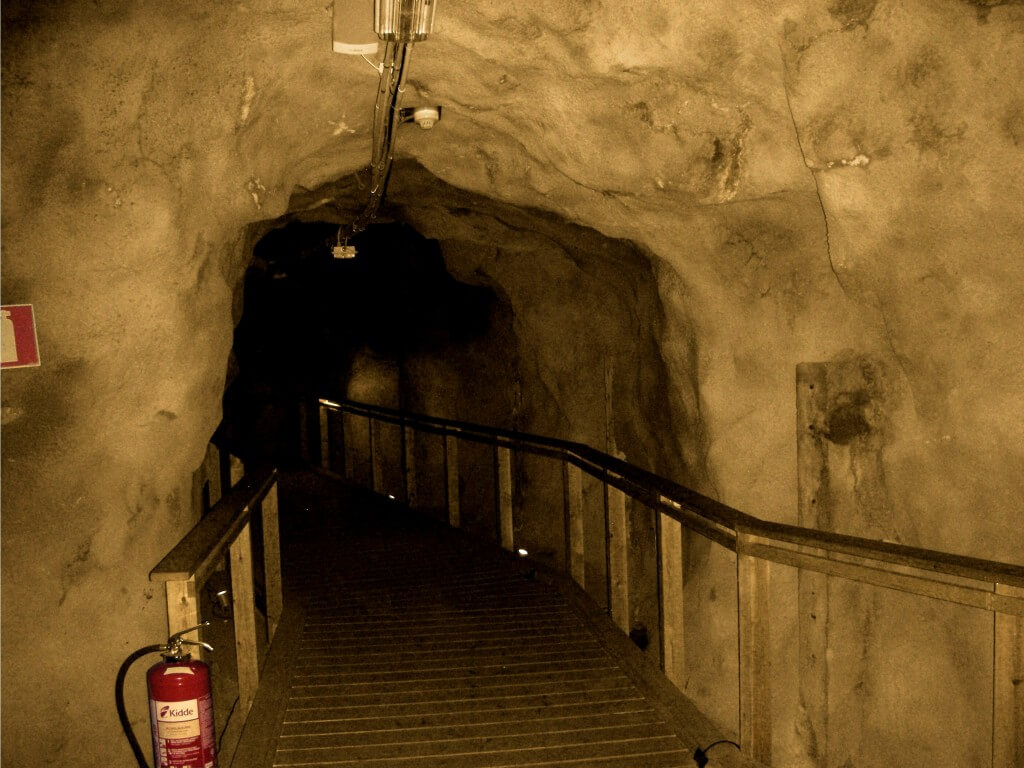
Initially, the tunnel was quite narrow, but it soon opened up to reveal several large caverns. The air was damp and cool inside and lights lined the bottom of the caves, which gave the whole place an eerie yellow glow. In some of the larger areas, there were big displays of equipment and supplies that were used when the tunnels were operational, including some underwater mines and an old machine gun. Every hour or so, an expert gave a talk about the tunnels during wartime. In total, the passages cover over 4,000 square metres below Skeppsholmen, although not everything was open to visitors. Occasionally, I came across a locked door that clearly wasn’t meant to be opened (at least not by me)!

 Cave Gate in Stockholm

If you are ever in Sweden on one of these “Secret Spaces” days, I definitely recommend taking a look down into Bergrummet on Skeppsholmen. It is one of my favourite places in Stockholm and from now on, every time I walk over this island, I’ll picture the old military men and women moving around in the hidden passages underneath my feet!


Top photo (Skeppsholmen) from Wikipedia.